

Roof Financing in Florida: How to Compare Options (APR, Terms, Payments, Pitfalls)
A roof replacement in Florida is rarely a discretionary purchase. The storm happened, the inspection revealed what you suspected, or the leak finally got bad enough that waiting is no longer realistic. And then come the numbers. $15,000, $27,000, $35,000 or more, and suddenly the question is not just which roof but how to pay for it.
Financing a roof is a reasonable and common decision. The question is how to do it without getting burned by terms you didn’t fully understand at signing. That’s what this guide covers: the main financing options available to Florida homeowners, what APR and loan terms actually mean in dollar terms, the specific pitfalls to watch for, and the questions you should be asking before you sign anything.
We offer financing options through our lending partners, and we include payment scenarios with every free estimate, so you can see what a project actually costs per month, not just as a lump sum. But this guide is written to help you evaluate any financing offer, from any source.
The Main Roof Financing Options
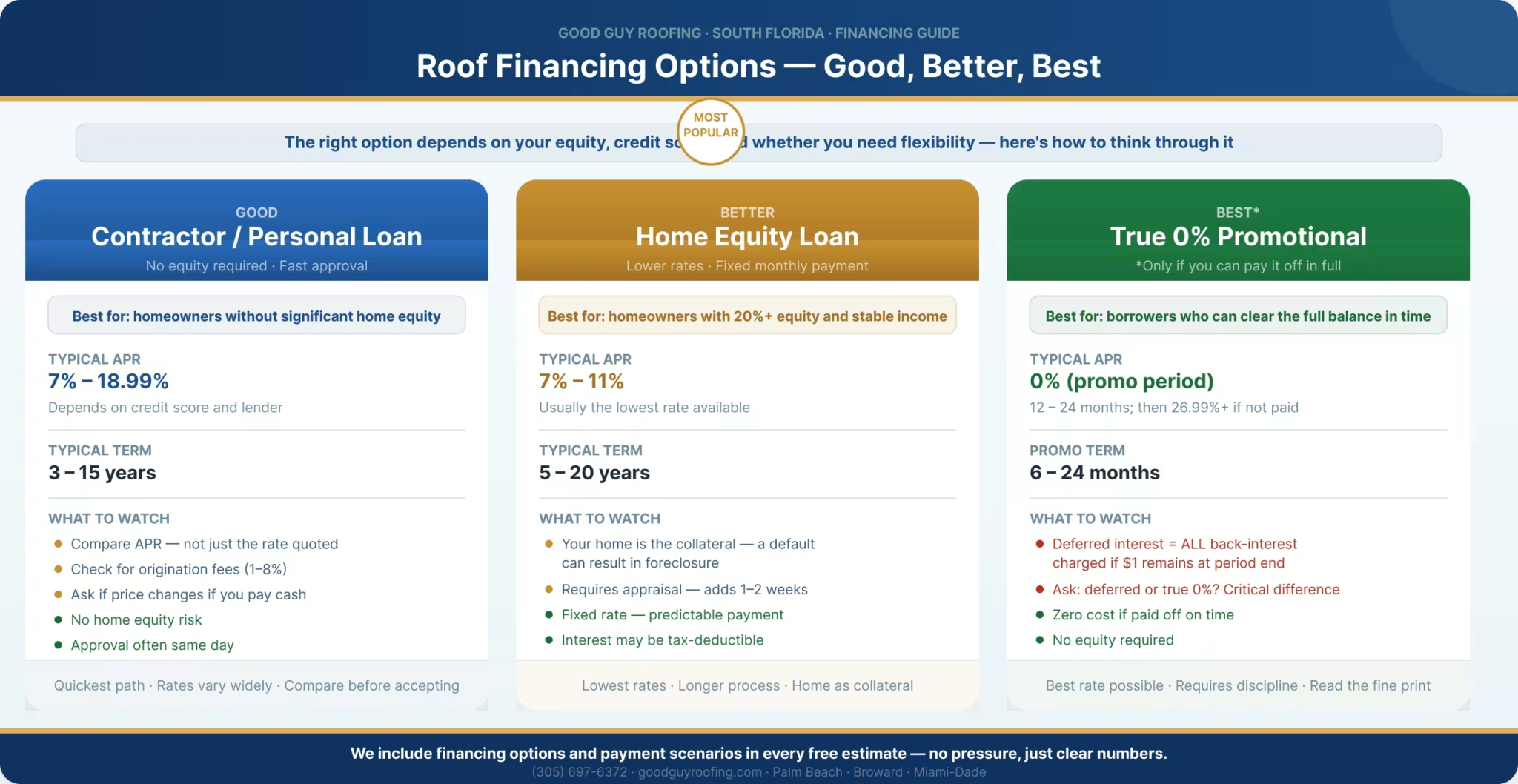
There are five primary ways Florida homeowners finance a roof replacement. Each has different eligibility requirements, interest rates, loan terms, and risk profiles. Here’s an honest breakdown.
| Option | Typical APR | Typical term | Secured? | Best for |
| Contractor financing (FHA Title I / private lender) | 6.99% – 18.99% | 3 – 15 years | No (most) | Homeowners who want a simple one-stop process with no equity required. |
| Home equity loan (HEL) | 7% – 11% | 5 – 20 years | Yes (home) | Those with significant equity who want a predictable fixed monthly payment. |
| Home equity line of credit (HELOC) | Prime + 0-2% | 10-yr draw / 20-yr repay | Yes (home) | Homeowners who may need funds in stages or want flexibility. |
| Personal loan (unsecured) | 8% – 36% | 2 – 7 years | No | Good credit borrowers who want speed and no lien on the property. |
| Promotional 0% APR (deferred interest) | 0% if paid off | 6 – 24 months | No | Borrowers who can comfortably pay the full balance before the promo period ends. |
| Insurance proceeds (partial financing) | N/A | N/A | No | Storm or wind damage claims – supplements other financing as needed. |
Please note that the figures above are estimates. APR ranges are indicative for well-qualified applicants in 2026. Actual rates depend on credit score, lender, and loan structure.
Contractor-Arranged Financing
This is the most common route for homeowners replacing a roof, and the most convenient, because the contractor handles the application process, and the financing is arranged as part of the same conversation as the job. Most reputable roofing contractors work with one or more lending partners who specialize in home improvement loans.
The main advantage is simplicity. No separate bank visit, no equity requirement, and funding is typically approved quickly. The main risk is not comparing the offer – it’s easy to accept the first number presented because you’re already in a project conversation. The rate may be perfectly competitive, or it may not be. Check it against what your bank or credit union would offer before signing.
Home Equity Loan (HEL)
A home equity loan lets you borrow against the equity you’ve built up in your home. You receive a lump sum at a fixed interest rate and repay it over a set term – typically five to twenty years. For homeowners with significant equity and good credit, this is often the lowest-rate option available, and the fixed payment structure makes budgeting straightforward.
The significant caveat: your home is the collateral. A default on a home equity loan can result in foreclosure. This is worth stating plainly, not to be alarming, but because it changes the nature of the decision. A contractor financing plan that falls behind can hurt your credit. A home equity loan that goes into default can cost you the house.
HELOC (Home Equity Line of Credit)
A HELOC works more like a credit card than a loan. You’re approved for a credit limit based on your equity, and you can draw from it as needed during the draw period, typically 10 years. You pay interest only on what you’ve drawn. After the draw period, the balance converts to a repayment phase.
For a roof replacement where you know the full cost upfront, a HELOC offers little practical advantage over a standard home equity loan, and its variable rate during the draw period introduces uncertainty. It’s more useful for homeowners tackling a series of home improvement projects where the total spend isn’t known in advance.
Personal Loans
Unsecured personal loans from banks, credit unions, and online lenders can be a good option for homeowners with strong credit who don’t want to put their home up as collateral or go through a contractor for financing. The rate range is wide – from around 8% for excellent credit to 36% or higher for poor credit – so the quality of the deal depends almost entirely on your credit profile.
The advantage over home equity products is speed and simplicity. Approval can happen within a day, and there’s no appraisal or title work required. For smaller repairs – say $5,000 to $10,000 – a personal loan is often the most practical option.
Promotional 0% APR Offers
Some contractor financing programs offer a promotional zero-interest period – typically 12 to 24 months – during which no interest accrues if the balance is paid in full. This is legitimately useful for homeowners who can comfortably pay off the balance within the promotional window.
The trap is the fine print. Most of these offers are deferred interest products, not true zero-interest loans. The distinction matters enormously: with deferred interest, if you have even $1 remaining on the balance when the promotional period expires, all of the interest that would have accrued from day one – at a rate that is typically 26.99% or higher – is added to your balance at once. Missing the payoff deadline by a month on a $20,000 loan could mean thousands of dollars in back interest appearing on your statement overnight.
| Deferred interest vs. true 0% APR:
Ask this specific question before accepting any promotional rate offer: “Is this a deferred interest product, or does the 0% apply only to the promotional period with no back-interest?” If the representative can’t answer clearly, treat it as a deferred interest product. True 0% financing – where interest genuinely doesn’t accrue – is available through some programs, but it’s less common than the deferred interest version that masquerades as the same thing. |
What Monthly Payments Actually Look Like
The table below shows realistic monthly payment estimates at common loan amounts, using two competitive rates and one higher rate to illustrate the difference. The right column shows how much total interest the highest-rate scenario adds over the life of the loan, which is the number many homeowners don’t look at until it’s too late.
| Loan amount | 7% / 5 years | 7% / 10 years | 12% / 10 years | Total paid at highest rate |
| $15,000 (shingles) | $297/mo | $174/mo | $215/mo | $25,800 – $10,800 in interest |
| $27,000 (tile) | $535/mo | $314/mo | $387/mo | $46,440 – $19,440 in interest |
| $35,000 (metal) | $693/mo | $407/mo | $501/mo | $60,120 – $25,120 in interest |
Estimated payments based on simple amortization. Actual figures depend on the lender, fees, and exact rate. For illustration only.
The takeaway from that table is this: the difference between a 7% and a 12% rate on a $27,000 tile roof is about $73 per month. That sounds manageable. Over ten years, it has become nearly $8,000 in additional interest. The monthly payment is not the right number to focus on – the total cost of the loan is.
| How to calculate total loan cost:
Multiply the monthly payment by the number of payments. Subtract the loan amount. The remainder is what you’re paying in interest. A ten-year loan at 12% on $27,000: $387/month × 120 months = $46,440 total. Minus $27,000 = $19,440 in interest. That’s a useful number to have before you sign. |
| See payment scenarios for your specific roof. Request a free estimate or call (305) 697-6372 |
Pitfalls to Watch For
These are the most common ways homeowners end up paying more than they expected.
Origination Fees
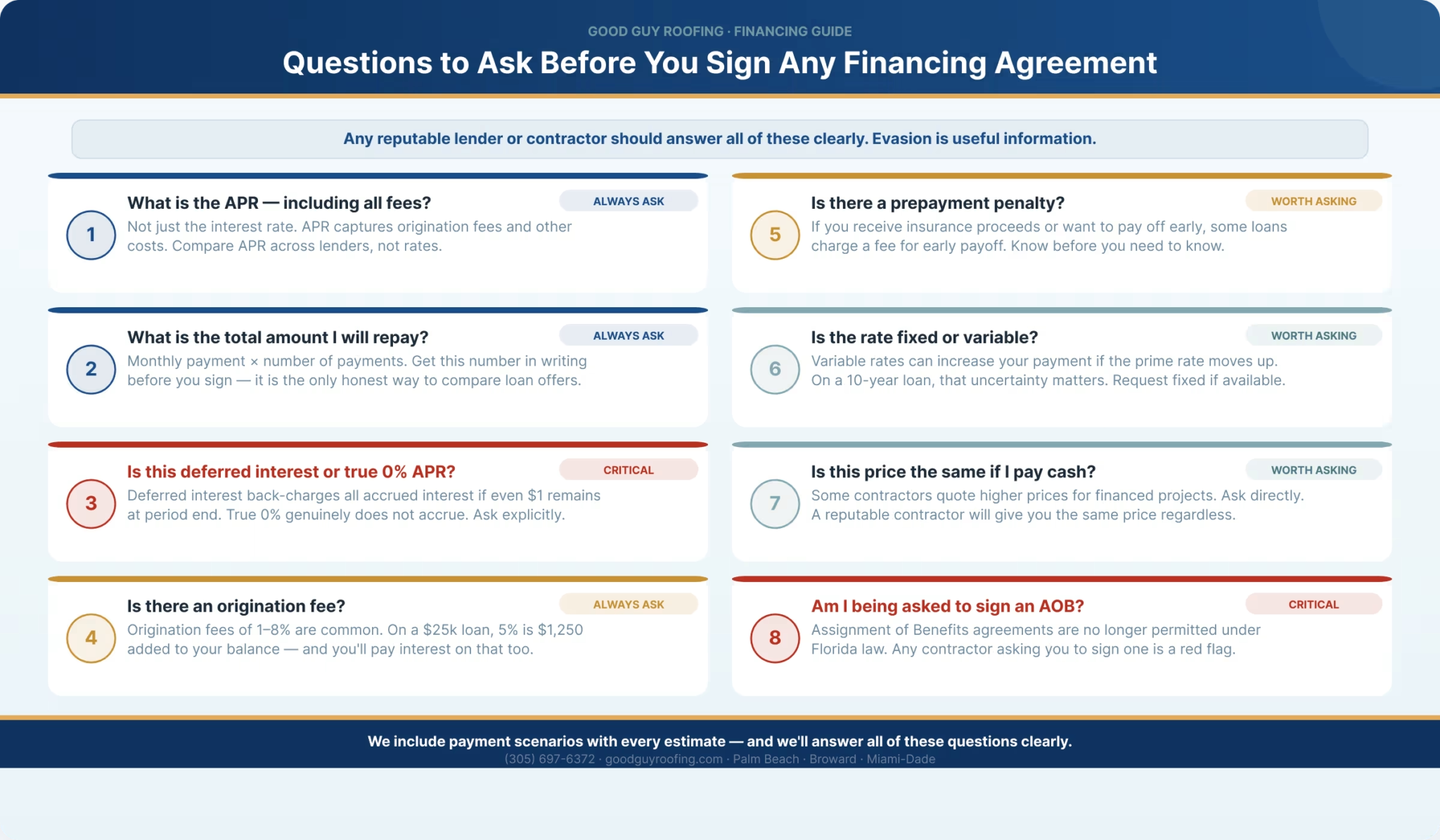
Many lenders, particularly in the home improvement financing space, charge an origination fee of 1% to 8% of the loan amount. This fee is often rolled into the loan, which means you’re paying interest on it too. On a $25,000 loan with a 5% origination fee, you’re starting the loan already $1,250 in the hole. Always ask: “What is the origination fee, and is it included in the APR figure you’re quoting?”
The APR figure (Annual Percentage Rate) is supposed to capture the total cost of borrowing, including fees, which is why it’s more meaningful than the interest rate alone. Make sure the APR you’re comparing across lenders is an apples-to-apples figure that includes all fees.
Prepayment Penalties
Some loan products charge a fee if you pay the loan off early. This is worth checking explicitly, especially if you expect to receive insurance proceeds, a tax refund, or other lump sums that you might want to apply to the balance. Ask: “Is there a prepayment penalty, and if so, what is it?”
Variable Rates
HELOCs and some personal loans have variable rates tied to the prime rate. In a stable rate environment, this may not matter much. But if you’re locking into a ten-year repayment on a variable rate product, an upward move in rates could meaningfully increase your monthly payment. If predictability matters to you, ask for a fixed-rate option.
Contractor Mark-Up on Financing
Some contractors mark up the project price when a customer is financing rather than paying cash. This isn’t universal, and most reputable contractors don’t do it – but it’s worth asking directly: “Is this price the same regardless of how I pay?” You’re entitled to a straight answer.
Signing Over Insurance Rights
This is less a financing pitfall than a broader one, but it surfaces most often when financing is involved. Some contractors ask homeowners to sign an Assignment of Benefits (AOB) agreement, which transfers your insurance claim rights to them. This is no longer permitted under Florida law following recent reforms. Any contractor asking you to sign an AOB should be an immediate red flag.
Questions to Ask Before Signing
Keep this list handy. Any reputable lender or contractor should be able to answer all of these clearly:
- What is the APR – and does that include all fees?
- Is this a deferred interest product, or a true 0%?
- What is the total amount I will repay over the life of the loan?
- Is there an origination fee? Is it included in the APR?
- Is there a prepayment penalty?
- Is the rate fixed or variable?
- What happens if I miss a payment?
- Is the project price the same regardless of how I pay?
If any of those questions are met with evasion, deflection, or pressure to sign before you’ve had time to think – that’s useful information about who you’re dealing with.
| Talk to a roofing specialist about financing options – no pressure, just clear information. Schedule a roof inspection |
Frequently Asked Questions
Can I finance roof repairs as well as a full replacement?
Yes, though the available options narrow for smaller amounts. Most home equity products have minimum loan amounts in the $10,000-$15,000 range. For a repair in the $1,000-$5,000 range, a personal loan or a contractor payment plan is typically more practical. For repairs in the $5,000-$15,000 range, a personal loan with a credit union or an online lender is usually the most competitive option. When you’re getting a repair estimate, ask your contractor whether they offer a payment plan for smaller jobs – many do.
What credit score is needed for roof financing?
It depends significantly on the product. Contractor-arranged financing through home improvement lenders often approves applicants with scores in the 580-620 range, though rates will be higher. Personal loans from banks typically require 660-700 for competitive rates. Home equity products generally want 680-720 or better. Some specialized programs serve borrowers with limited credit history, though at significantly higher rates. The honest answer is: the higher your credit score, the more options you have and the lower the rates. If your credit score is a concern, it’s worth getting pre-qualified through a few channels before committing to the first offer you receive.
Are there genuine zero-interest financing options?
Yes, but they’re less common than they appear. True 0% financing – where interest genuinely does not accrue during the promotional period – does exist through certain manufacturer programs and some lender partnerships. What’s far more common is deferred interest, which charges no interest during the promotional period but back-bills all accrued interest if the full balance isn’t paid by the end date. Always ask explicitly which type you’re being offered. For a true 0% offer to be useful, you need a realistic plan to pay the full balance before the period expires – not just the minimum payments.
Does financing affect my roof warranty coverage?
The financing arrangement itself shouldn’t affect your material warranty or the contractor’s workmanship warranty – those are separate agreements. What can affect warranty coverage is who installs the roof. Some manufacturer warranties require installation by a certified contractor. Make sure the contractor you’re using is certified for the materials being installed, regardless of how the job is financed. Ask for the warranty documentation in writing before the job starts and keep a copy after completion.
What documents do I need to apply for roof financing?
For most contractor-arranged and personal loan applications, you’ll typically need: proof of identity (driver’s license or passport), proof of income (recent pay stubs or two years of tax returns if self-employed), proof of homeownership (mortgage statement or property tax bill), and your Social Security number for the credit pull. For home equity products, add: a recent mortgage statement showing the outstanding balance, and possibly a property appraisal – though some lenders use automated valuation models that don’t require a formal appraisal. Having these ready before you apply speeds the process considerably.
Financing a Roof the Right Way
Roof financing is not inherently a bad deal – it’s how many homeowners responsibly manage a large, necessary expense. The difference between a good financing outcome and a costly one usually comes down to a few things: understanding what you’re actually signing, comparing total cost rather than monthly payment, and asking the questions that lenders and some contractors would rather you didn’t.
A roof that lasts 40 years and is financed at a competitive rate is a sound investment. The same roof, financed at 26.99% on a deferred-interest product that rolled over, is much more expensive. The math isn’t complicated – it just requires asking for the right numbers upfront.
When you request an estimate from Good Guy Roofing, we include payment scenarios for multiple financing options as part of that conversation. You’ll see exactly what the project costs per month, what the total repayment is, and what options are available to you – before you commit to anything.


