
Flat Roof Replacement Options for Florida: Modified Bitumen vs TPO vs Coatings
Flat roof replacements and flat roofs in general, or more accurately, low-slope roofs, are common in South Florida in ways that might surprise homeowners who moved from other parts of the country. Florida ranch homes, additions, garages, commercial properties, and many mid-century residential builds all use low-slope systems. And while they tend to be out of sight and out of mind until something goes wrong, choosing the right system when it does need replacing makes a significant difference in how long the next one lasts and what it costs to own.
The three main categories of residential and light commercial flat roofing available in Florida are modified bitumen, TPO single-ply membrane, and roof coatings. Each has genuine strengths and genuine weaknesses in the Florida context.
None is universally the best choice – the right answer depends on the roof’s current condition, its size and configuration, how much foot traffic it sees, the budget, and how long the owner plans to be in the property.
This guide covers each system honestly, explains the most common flat roof problems in Florida’s climate, and helps you ask the right questions before committing to a system or a contractor.
Understanding Low-Slope Roofing in Florida’s Climate
Before comparing systems, it helps to understand what specifically makes flat roofing harder in Florida than in most of the country. The challenges are different from those faced by pitched roofs, and they compound each other.
Heat and UV Intensity
South Florida receives more solar radiation than almost anywhere else in the continental US. A dark or medium-colored flat roof surface in Miami or Fort Lauderdale absorbs enormous heat loads – enough to accelerate the oxidation and cracking of roofing membranes that might perform well for 25 years in a more temperate climate.
This is why heat reflectance matters more for flat roofs in Florida than in virtually any other state. A white TPO or silicone-coated surface that reflects 70–85% of solar radiation runs significantly cooler, extends membrane life, and reduces the air conditioning load on the building below.
Ponding Water
Ponding water – water that remains on the roof surface 48 hours or more after a rain event – is the defining threat to any flat roof system. Florida’s rainy season delivers enormous volumes of water in short bursts: 1 to 3 inches in a single afternoon storm is common. A flat roof that doesn’t drain properly will pond, and ponding water accelerates the deterioration of all membrane types.
Ponding is caused by inadequate slope, blocked drains, drain positioning that doesn’t account for the roof’s actual low spots, or structural deflection over time. Some degree of ponding is present on nearly every truly flat roof – the question is whether it resolves within 48 hours. If it doesn’t, it needs to be addressed structurally before a new membrane is installed, because no membrane material performs well under sustained water load.
| Important:
Ponding water is not fixed by installing a better membrane. If the drainage is inadequate, it will pond on the new membrane too. Any flat roof proposal that doesn’t address drainage – either by adding drains, repositioning them, or installing tapered insulation to create slope toward existing drains – should prompt a question about why. |
Hurricane Wind Uplift
All of South Florida sits in the High-Velocity Hurricane Zone, and flat roof systems must be installed to meet Florida Building Code uplift requirements. This affects both the system choice and the installation method. TPO membranes, for example, can be mechanically fastened, adhered, or ballasted – and only mechanically fastened or fully adhered systems are permitted in the HVHZ. How a flat roof is attached to the deck is as important as what it’s made of.
Humidity and Moisture Infiltration
Warm, humid air rising from the building interior below can condense in the roof assembly, degrading insulation and promoting mold or rot in the deck. Flat roof assemblies in Florida need to be designed with moisture management in mind – which affects insulation specification, vapor control, and the choice of membrane.
The Three Main Systems – Compared Honestly
| System | FL lifespan | Installed cost / sq ft | Heat reflectance | Best fit |
|---|---|---|---|---|
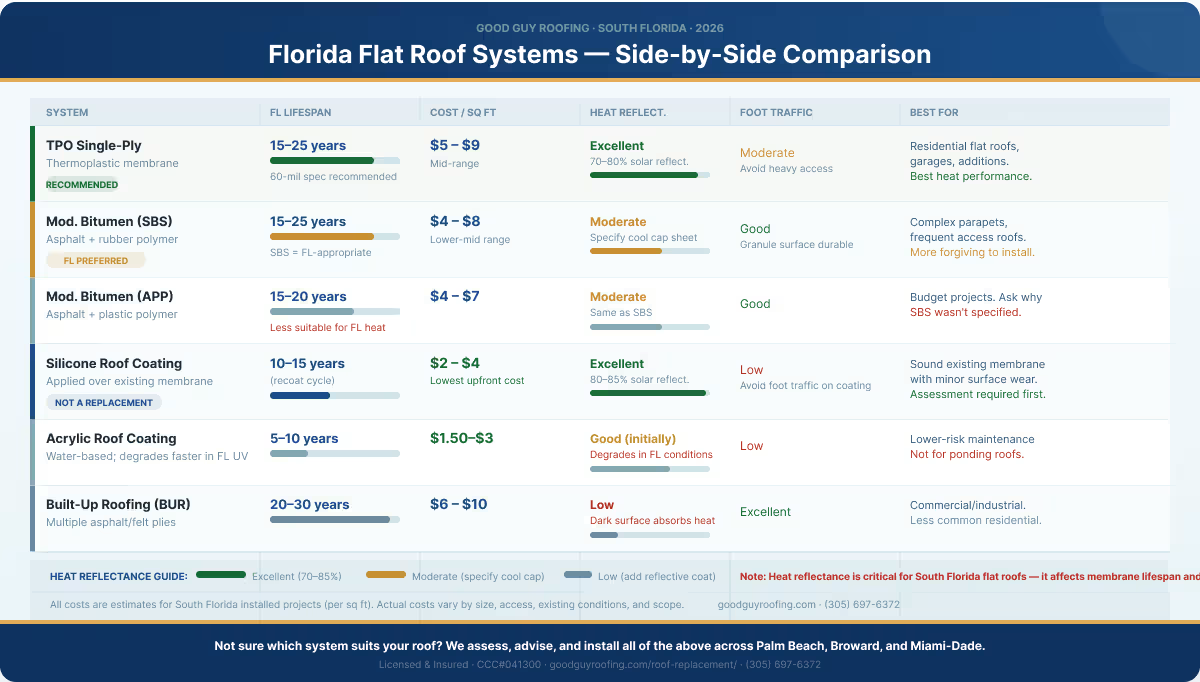
| TPO (single-ply membrane) | 15 – 25 years | $5 – $9 | Excellent (white reflects 70–80% solar heat) | Residential flat roofs, additions, garages – best heat performance per dollar |
| Modified bitumen (SBS) | 15 – 25 years | $4 – $8 | Moderate (granule surface absorbs heat; cool-coat option available) | Roofs with parapets, difficult penetrations, or frequent foot traffic |
| Modified bitumen (APP) | 15 – 20 years | $4 – $7 | Moderate (same as SBS; granule cap can be light-colored) | Budget-sensitive projects; not ideal for high-UV South Florida coastal zones |
| Silicone roof coating | 10 – 15 years (recoat cycle) | $2 – $4 | Excellent (white silicone reflects 80–85% solar heat) | Roofs with a structurally sound existing membrane that has begun to leak |
| Acrylic roof coating | 5 – 10 years | $1.50 – $3 | Good (high reflectance when new; degrades faster in FL UV) | Roofs in lower-risk applications or as a maintenance layer on modified bitumen |
| Built-up roofing (BUR) | 20 – 30 years | $6 – $10 | Low (dark surface without reflective cap) | Commercial and industrial; less common on residential in South FL today |
Costs are estimates for South Florida residential and light commercial projects. Actual costs vary by roof size, complexity, access, and existing conditions.
TPO (Thermoplastic Polyolefin)
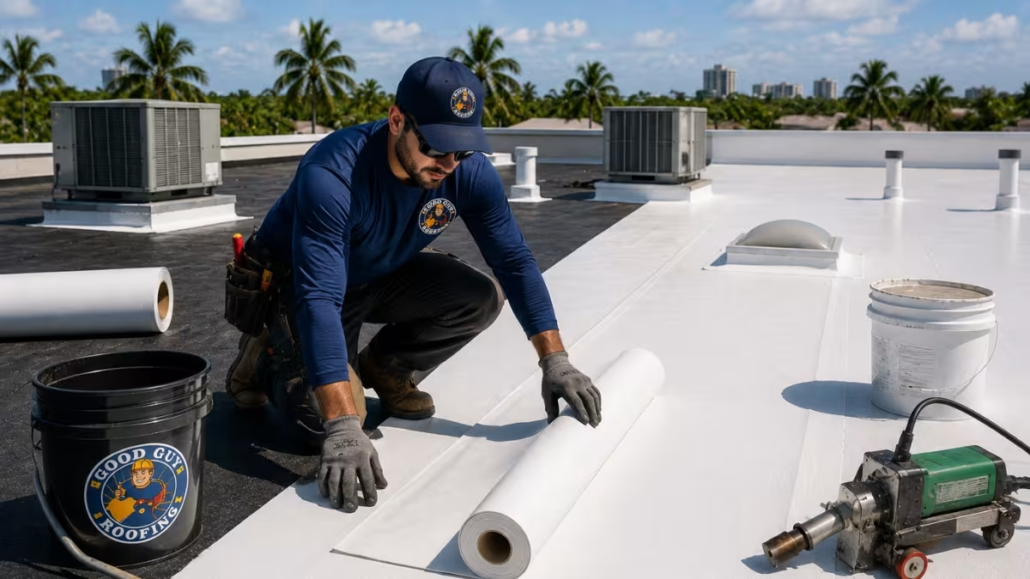
TPO is the dominant single-ply roofing membrane in the US market today, and for residential flat roofing in Florida it is often the most practical choice. A white TPO membrane reflects heat effectively, welds at the seams with hot air rather than relying on adhesives or embedded granules, and is available in Florida Product Approval configurations for HVHZ installations.
What TPO does well in Florida:
- Heat reflectance – white TPO typically reflects 70–80% of solar radiation, keeping the membrane and the space below significantly cooler than a dark modified bitumen surface
- Seam strength – heat-welded seams are stronger than adhesive-bonded ones and more reliable in Florida’s thermal cycling environment
- Flexibility – TPO remains flexible in temperature extremes, which matters for roofs over living spaces where structural movement occurs
- Code compliance – many TPO products have Miami-Dade NOA and Florida Product Approval for HVHZ installations
What to watch for with TPO:
- Quality variation – TPO quality varies significantly by manufacturer and thickness; 60-mil is the standard residential specification and anything thinner should be questioned
- Installation sensitivity – seam quality depends entirely on the installer’s technique and equipment; a poorly welded seam on a TPO roof leaks as readily as any other membrane failure
- Ponding vulnerability – TPO performs poorly if water ponds persistently; drain adequacy must be assessed before installation
Modified Bitumen
Modified bitumen is an asphalt-based membrane reinforced with either SBS (styrene-butadiene-styrene) or APP (atactic polypropylene) polymers. It has been the workhorse of residential flat roofing for decades and remains a solid system when correctly specified and installed.
There are two installation methods relevant in Florida: torch-down (heat-fused to the substrate or prior layer) and cold adhesive/peel-and-stick. Torch applications are common but require a licensed applicator and appropriate fire safety procedures. Cold-applied systems are safer and increasingly preferred by insurers.
What modified bitumen does well in Florida:
- Durability under foot traffic – granule-surfaced modified bitumen withstands foot traffic better than TPO, making it preferable for roofs that are accessed regularly for HVAC service or maintenance
- Resistance to puncture – the bituminous layers provide more puncture resistance than single-ply membranes
- Detail flexibility – modified bitumen handles complex flashings, parapets, and penetrations more forgivingly than single-ply systems
- Familiar to more contractors – a larger pool of qualified applicators in South Florida
What to watch for with modified bitumen:
- Heat absorption – a dark granule-surfaced modified bitumen roof runs significantly hotter than white TPO; a cool-coat or reflective cap sheet should be specified in Florida wherever possible
- Seam vulnerabilities – lapped seams are the most common failure point; torch-applied seams that are under- or over-fused both fail
- Cracking over time – APP-modified bitumen is less flexible than SBS at South Florida temperatures; SBS is generally preferred for Florida applications
| SBS vs APP in Florida:
SBS-modified bitumen remains flexible at higher temperatures than APP, which is why it generally performs better in South Florida’s heat. APP was developed for European climates where heat is less extreme. If a contractor is proposing APP for a South Florida flat roof without a clear reason, ask why SBS was not specified. |
Roof Coatings (Silicone and Acrylic)
Roof coatings are not the same as replacing a roof, and the distinction matters enormously. A coating is applied over an existing membrane to extend its life, improve reflectance, or stop minor leaks. It is not a structural solution and it cannot fix a membrane that has failed at the seams, a deck that is wet, or a drainage problem.
That said, for the right roof – one with a structurally sound existing membrane that has begun to show surface deterioration and minor cracking – a silicone coating can be a genuinely cost-effective option that adds 10 to 15 years of service life at a fraction of replacement cost.
Silicone coatings in Florida:
- Excellent UV and heat resistance – silicone retains its reflectance and flexibility in Florida’s UV environment better than acrylic
- Ponding water tolerance – uniquely among coating types, silicone is not significantly degraded by standing water, which matters given Florida’s drainage realities
- Cannot be recoated with acrylic – silicone-over-silicone is fine; acrylic over silicone does not bond well
- Best applied at 20–30 mils dry film thickness for Florida conditions – thinner applications do not hold up
Acrylic coatings in Florida:
- Lower cost than silicone, but shorter effective life in Florida’s UV exposure
- Good initial reflectance that degrades faster than silicone over time
- Softens and is damaged by persistent ponding water – a significant limitation in Florida where ponding is common
- More suitable for maintenance applications on modified bitumen than as a primary waterproofing solution
| When coatings are and aren’t appropriate:
Appropriate: existing membrane is structurally intact with no active seam failures, no wet insulation, no deck damage. Minor surface cracking or granule loss. Drainage is adequate. Budget is a constraint. Not appropriate: active seam failures or open laps. Evidence of wet insulation (thermal imaging will show this). Persistent ponding deeper than 1/4 inch. Deck deterioration. Multiple prior coating layers that have delaminated. |
| Not sure if you need a coating or a full replacement? Ask about coatings vs full replacement – or call (305) 697-6372 |
Common Flat Roof Leak Areas in Florida
Regardless of membrane type, flat roofs in Florida tend to leak at the same locations. Knowing where to look – or what to ask your inspector about – focuses the conversation.
Penetrations
Every pipe, conduit, HVAC unit curb, drain, and skylight that passes through the flat roof is a potential leak point. The membrane must terminate and seal against these penetrations, and the sealants and flashings that accomplish this degrade in Florida’s UV and heat environment faster than they do in most climates. Penetrations should be inspected at every maintenance visit and after every major storm.
Field Laps and Seams
The field of the membrane – the large flat area between penetrations – fails most often at laps and seams. In modified bitumen, laps that were not fully heated and bonded during installation will eventually open. In TPO, seams that were welded at incorrect temperature will delaminate. In coated roofs, the coating can delaminate from an existing membrane at areas of poor adhesion or prior moisture.
Parapets and Edge Flashings
Parapet walls – the vertical walls at the edge of a flat roof – require the membrane to terminate and be counter-flashed. This junction is one of the most common leak points on flat roofs because it involves two planes of movement (the flat field and the vertical wall), the effects of thermal expansion, and often substandard original flashing details that were not designed for South Florida wind events.
Drains and Low Spots
Drain clamping rings compress and seal the membrane around the drain opening. These rings must be properly torqued and the membrane must be laid into the drain correctly. A drain that was not sealed properly at installation, or whose clamping ring has loosened over time, is a reliable leak source that is also easy to miss visually because the drain appears functional.
HVAC Unit Bases and Curbs
HVAC equipment sitting on the flat roof is supported by raised curbs that the membrane flashes up and over. Condensate from HVAC units, foot traffic from service visits, and the vibration of equipment in operation all create stress on the membrane and flashings at these locations. They are among the most commonly overlooked sources of flat roof leaks in residential and commercial properties.
Flat Roof Maintenance in Florida: What a Good Schedule Looks Like
Flat roofs require more active maintenance than pitched roofs. The absence of slope means water, debris, and biological growth all accumulate rather than washing off. A maintenance schedule appropriate to Florida conditions looks like this:
- Twice a year: Full visual inspection of all penetrations, seams, drain covers, and parapet flashings. Clear any debris from drains and drain sumps. Check for granule buildup around drains (indicates membrane surface wear).
- After every named storm: Post-storm inspection of the full field, all penetrations, and all edge details. Driving wind and rain stress flat roof flashings in ways that are not visible without getting on the roof.
- Every 3–5 years: Professional infrared or moisture scan of the roof assembly. This detects wet insulation that is invisible to a visual inspection and allows targeted repair before wet insulation compromises the deck.
- At first sign of interior water: Do not wait. Flat roofs that leak often allow water to travel laterally within the assembly before it appears inside – which means the leak point may be feet or even yards from the stain.
Contact us for more on regular roof maintenance
Frequently Asked Questions About Flat Roof Replacement
What’s the best material for a flat roof replacement in Florida?
For most residential flat roofs in South Florida, white TPO is the best starting point – it offers the best heat reflectance per dollar, reliable seam performance when correctly installed, and Florida Product Approval availability for HVHZ. That said, the answer genuinely depends on the roof’s specifics. If the roof has complex parapet details, frequent foot traffic, or a tight budget, modified bitumen (SBS-type) may be more appropriate. If the existing membrane is structurally sound, a silicone coating may be the most cost-effective path. There is no single best material – there is a best material for your specific roof, budget, and situation, which is what a proper inspection is designed to determine.
How long does a TPO roof last in Florida?
A quality TPO installation on a properly drained roof in South Florida typically lasts 15 to 25 years. The range is wide because longevity depends heavily on several factors: the membrane thickness (60-mil lasts significantly longer than 45-mil), the seam quality at installation, how well the roof drains (ponding water accelerates degradation), whether it receives regular maintenance, and how much UV exposure the specific roof gets. A TPO roof that is well-installed on a roof with good drainage and receives biannual inspections is much more likely to reach the upper end of that range than one that is installed and forgotten. The manufacturer’s warranty – typically 15 to 20 years on commercial-grade products – is a useful proxy for expected lifespan, but it comes with installation and maintenance conditions that must be met to remain valid.
Can a roof coating stop my flat roof from leaking?
It depends entirely on the cause and extent of the leak. A roof coating can effectively stop minor surface cracking, small pinholes in an otherwise intact membrane, and general surface porosity – and in those cases it can add a meaningful number of years to the roof’s service life at low cost. What a coating cannot do is fix a seam that has opened, repair a membrane that has delaminated from the deck, address wet insulation, or solve a drainage problem. If the leak is coming from a failed seam or a penetration flashing failure, a coating applied over it will bridge the gap temporarily but will not bond durably to the open seam and will likely fail at the same location within a season or two. A proper assessment before coating is essential – applying coating to a roof that needs replacement delays a necessary decision and can mask deterioration that becomes more expensive to address later.
What causes ponding water on flat roofs, and how is it fixed?
Ponding water on a flat roof has four main causes: insufficient roof slope (most flat roofs need at least 1/4 inch of drop per foot to drain effectively), blocked or undersized drains, structural deflection in the deck or framing that has created low spots over time, and drain positioning that doesn’t align with the roof’s actual low spots. The fix depends on the cause. Blocked drains are simple maintenance. Undersized or misplaced drains require drain additions. Structural deflection may require tapered insulation installed over the existing deck to create slope toward existing drains – this is the most common structural solution and can be incorporated into a membrane replacement. Ponding is not fixed by the membrane itself, and a contractor who proposes a new membrane without addressing the drainage issue is leaving the underlying problem in place.
Is a flat roof more expensive to maintain than a pitched roof?
Generally yes – but the gap is smaller than many homeowners expect, and it depends significantly on whether the flat roof is properly maintained or neglected. A flat roof that receives biannual inspections and prompt attention to minor issues is not dramatically more expensive to maintain than a pitched roof. A flat roof that is ignored until it leaks significantly often ends up with wet insulation and deck damage that turns a straightforward membrane replacement into a much more involved and costly project. The maintenance cost difference is real, but it is largely a function of the frequency of professional attention required rather than an inherent cost disadvantage of the system. For homes with a combination of pitched and flat sections – which is common in South Florida with additions and garages – the flat section typically requires more active monitoring than the pitched portion.
Choosing the Right Flat Roof System for Your Florida Property
The most important thing to understand about flat roofing in Florida is that system selection and installation quality matter more than they do on a pitched roof. A pitched tile or shingle roof has gravity working in its favor – water sheds naturally even if the installation isn’t perfect. A flat roof has to work harder, in a more demanding climate, with less margin for error.
TPO is the right starting point for most residential flat roofs in South Florida. Modified bitumen is the right answer for roofs with complex details, heavy traffic, or specific performance requirements. Coatings are the right answer for roofs that are still structurally sound and need an extended service life at a lower upfront cost. And in every case, getting the drainage right – before or alongside the new membrane – is as important as any material decision.
If you have a flat or low-slope roof anywhere on your property and you’re not sure of its age, condition, or drainage adequacy, an inspection is the right next step. We assess flat roofs across Palm Beach County, Broward County, and Miami-Dade County and provide a written report with specific recommendations – whether that’s a coating, a targeted repair, or a full replacement.


