
Cool Roofs in Florida: Can the Right Roof Lower Your AC Bill?
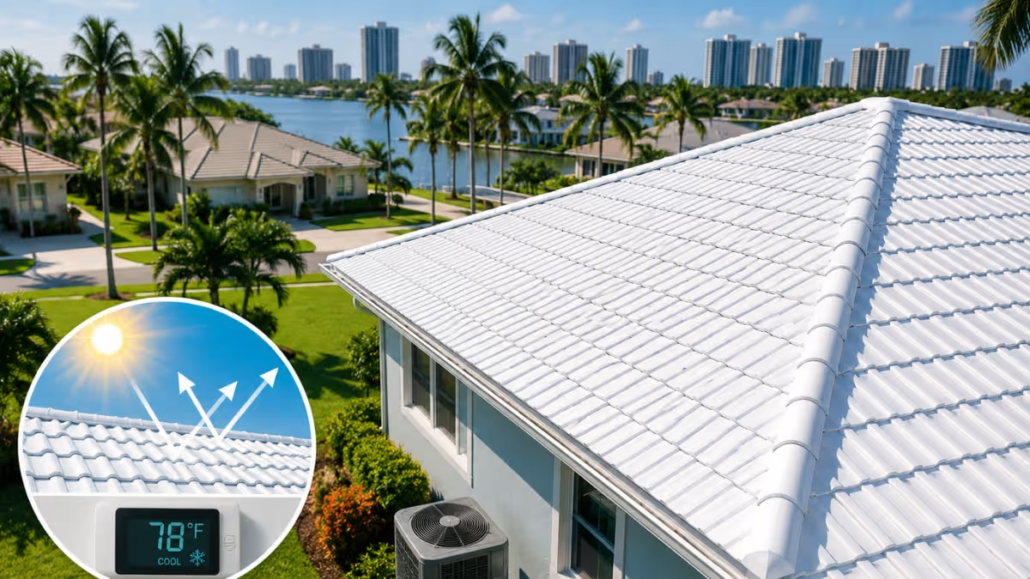
If your air conditioner runs almost continuously from May through October, the cool roof above you is probably part of the reason.
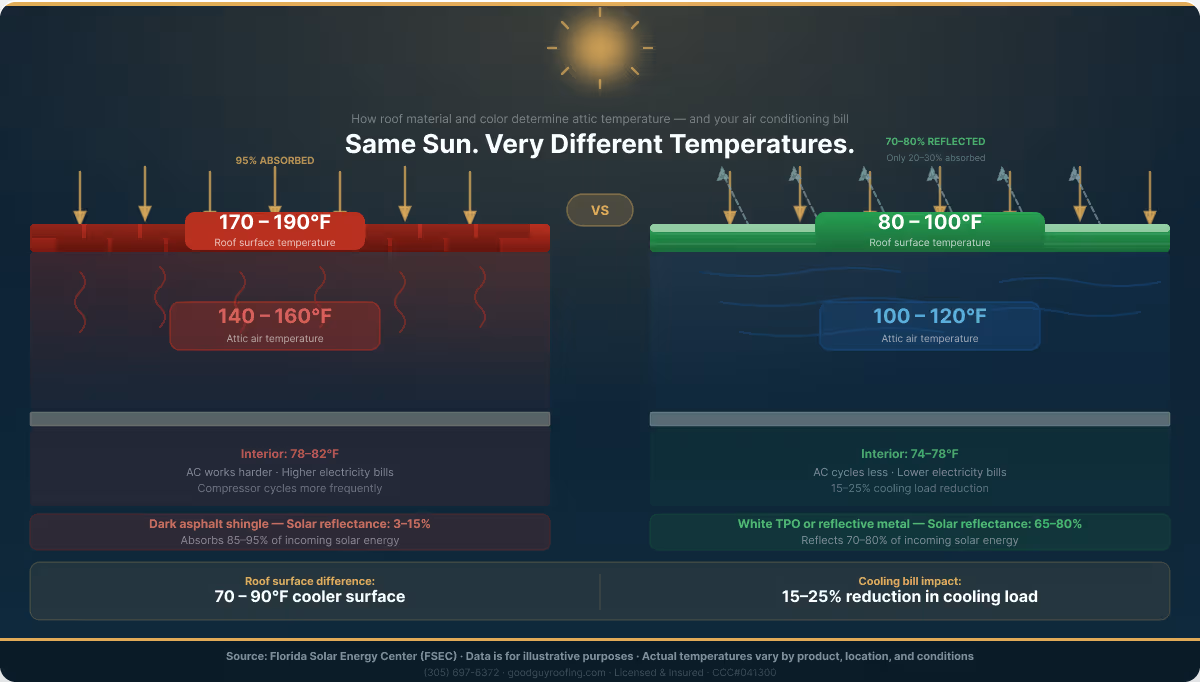
A standard dark asphalt shingle roof in South Florida can reach surface temperatures of 170 to 190 degrees Fahrenheit on a sunny afternoon.
That heat radiates into the attic, which radiates into the living space, which your AC then has to fight against. For a 2,000-square-foot home with poor attic ventilation and a dark roof, the energy penalty is real and measurable.
The good news is that roofing material choice, color, and attic conditions together have a meaningful impact on cooling loads – and if you’re already planning a roof replacement, the incremental cost of choosing an energy-efficient option is modest compared to the long-term savings.
This guide explains how cool roofs work in Florida specifically, which materials and colors perform best, and how to estimate what the difference might actually mean for your electricity bill.
| Interested in energy-efficient roofing options? Ask about energy-efficient options – Call (305) 697-6372 |
What Is a Cool Roof, and Does the Concept Apply in Florida?
A cool roof is any roofing system designed to reflect more of the sun’s energy back into the atmosphere rather than absorbing it into the building structure. Two properties define how well a roof does this:
- Solar reflectance (albedo): The fraction of incoming solar radiation that the roof reflects rather than absorbs. A perfectly reflective surface would have a solar reflectance of 1.0; a perfectly absorptive surface would have a solar reflectance of 0. A standard dark asphalt shingle has a solar reflectance of around 0.05 – it absorbs 95% of the solar energy that hits it. A white TPO membrane reflects 70 to 80%.
- Thermal emittance: The ability of the surface to release absorbed heat rather than store it. Most painted and coated surfaces have high thermal emittance (above 0.80), meaning they radiate heat away efficiently. Bare unpainted metal has low emittance – it absorbs less radiation but stores and slowly releases what it does absorb.
The Energy Star Roof Products program sets minimum thresholds for certified cool roofs: solar reflectance of at least 0.25 for steep-slope products and 0.65 for low-slope products, with thermal emittance of at least 0.75 for both. Products meeting these thresholds qualify for utility rebates in many Florida counties.
| Does this actually work in a humid climate like Florida?
Yes, and in some ways, Florida benefits more than drier climates. The concern often raised is that humid air reduces the temperature differential, making cool roofs less effective. Studies from the Florida Solar Energy Center (FSEC) have found that cool roofs in Florida reduce attic temperatures by an average of 20 to 30 degrees Fahrenheit compared to dark roofs, and reduce peak cooling loads by 15 to 25%. The humidity doesn’t negate this – the attic temperature reduction is a direct result of less solar absorption, which humidity doesn’t affect. |
Solar Reflectance by Roofing Material
How a roofing material performs as a cool roof depends on both its composition and its color. The table below shows solar reflectance and thermal emittance for the materials most commonly used in South Florida.
| Roofing material | Solar reflectance | Thermal emittance | Florida context |
|---|---|---|---|
| White TPO (flat roof) | 70 – 80% | 0.85 – 0.90 | Best cool-roof performance available. Standard for flat roofs. Qualifies for Energy Star and utility rebates. |
| White metal (standing seam) | 65 – 75% | 0.85 | Excellent for pitched roofs. Long-lived coating retains reflectance. PVDF coating required in coastal zones. |
| Concrete tile – light gray/white | 35 – 55% | 0.85 – 0.90 | Air gap beneath tiles adds benefit. Lighter colors perform significantly better than terracotta. Popular in FL. |
| Reflective shingle (Energy Star) | 25 – 40% | 0.85 – 0.91 | Standard shingles refined with reflective granules. Better than dark shingle but limited by granule color. |
| Standard dark asphalt shingle | 3 – 15% | 0.85 – 0.91 | Absorbs most solar radiation. Roof deck temperature up to 190°F on a sunny FL day. Worst performing option. |
| Clay tile – terracotta | 20 – 35% | 0.85 – 0.90 | Absorbs more heat than lighter options. Air gap beneath tiles partially compensates for low reflectance. |
| Dark gray/charcoal metal | 20 – 35% | 0.85 | Loses most of the cool-roof benefit of metal. Specify lighter color if energy performance is a priority. |
| Unpainted galvalume/bare metal | 50 – 65% | 0.10 – 0.25 | High reflectance but very low emittance – stores heat and releases it slowly. Not ideal for cooling. |
Reflectance values are approximate and vary by product, color, and manufacturer. Values from FSEC, Lawrence Berkeley National Laboratory, and Energy Star databases.
The Color Factor
For any given material, color is the single biggest determinant of solar reflectance. A light gray concrete tile reflects roughly twice as much solar energy as a terracotta tile of the same profile. A white metal panel reflects four to five times as much solar energy as a charcoal panel of the same metal and coating.
This matters most for homeowners replacing a roof who are considering color options. The structural and waterproofing performance of the material is the primary consideration, but within a material category, color selection can significantly affect energy performance.
The practical implication: if you’re replacing a tile roof and considering color options, light gray or off-white tile will meaningfully outperform terracotta in terms of energy performance, at no additional cost. If you’re replacing a metal roof and choosing between dark and light panels, the light option has a measurable long-term energy advantage.
The Tile Air Gap Effect
Concrete and clay tile roofs have a structural advantage that partially compensates for lower-reflectance colors: the tiles sit on battens above the underlayment, creating an air gap that allows some convective heat to be drawn away from the deck. Studies suggest this air gap provides the equivalent of R-2 to R-4 additional thermal resistance. It’s why a terracotta tile roof, despite relatively low solar reflectance, often performs better in energy terms than a dark shingle roof – the air circulation under the tile recovers some of what the color loses.
| Book a free inspection and ventilation check – we’ll assess your roof’s current energy performance – (305) 697-6372 |
Ventilation and Insulation: The Other Half of the Equation
Reflective roofing materials reduce the heat entering the attic. Ventilation and insulation determine what happens to that heat once it’s there. A cool roof material with inadequate attic ventilation will still cause the living space to overheat. And adequate ventilation without a reflective material still means the attic is absorbing more heat than it needs to.
The two work together. Getting one right without the other leaves significant energy savings on the table.
Attic Ventilation
The purpose of attic ventilation in Florida is to allow hot air to escape continuously during the day, preventing heat buildup that transfers into the living space. The standard building code requirement is one square foot of net free ventilation area per 150 square feet of attic space – but this is a minimum, and many Florida homes don’t meet even this threshold, especially older homes where soffits are blocked or ridge vents were never installed.
A properly ventilated attic has:
- Soffit vents along the eaves – where cool air enters from outside
- Ridge vent or equivalent high-point exhaust – where hot air exits (heat rises)
- Clear air channel from soffit to ridge – insulation baffles prevent blocking at the eave line
- No obstructions – attic insulation pushed against the eaves, blocks soffit intake, and defeats the ventilation system
In South Florida’s climate, a well-ventilated attic can be 20 to 40 degrees cooler than a poorly ventilated one, which directly reduces the load on the ceiling below it. This temperature differential is often as large as the benefit from switching to a reflective roofing material, which is why inspecting ventilation at the same time as the roof itself is valuable.
| Power ventilators:
Powered attic fans are sometimes proposed as a ventilation solution. The evidence on their effectiveness is mixed – a well-designed passive ventilation system (soffit + ridge) often outperforms a power ventilator, and power ventilators can actually depressurize the attic and pull conditioned air from the living space through gaps. Fix passive ventilation first before considering powered solutions. |
Attic Insulation
In Florida’s climate, attic floor insulation is what separates the living space from the attic heat. The Florida Building Code requires a minimum of R-30 for existing homes and R-38 for new construction in most of the state. Homes built before the mid-1990s frequently have significantly less insulation than this, and many have had insulation compressed over time, reducing its effective R-value.
Unlike northern climates, where insulation is primarily about retaining heat in winter, Florida’s insulation job is predominantly about blocking downward heat transfer from a hot attic into the air-conditioned space below. Adding insulation in an under-insulated Florida attic is often the single highest-ROI energy improvement available – it can be done cheaply compared to a roof replacement, and the savings are immediate.
The order of priority for energy performance: (1) verify and fix attic ventilation, (2) add insulation if below R-30, (3) choose a reflective roofing material at next replacement. Doing all three together yields the largest savings.
Estimating Your Potential Savings – A Simple Worksheet
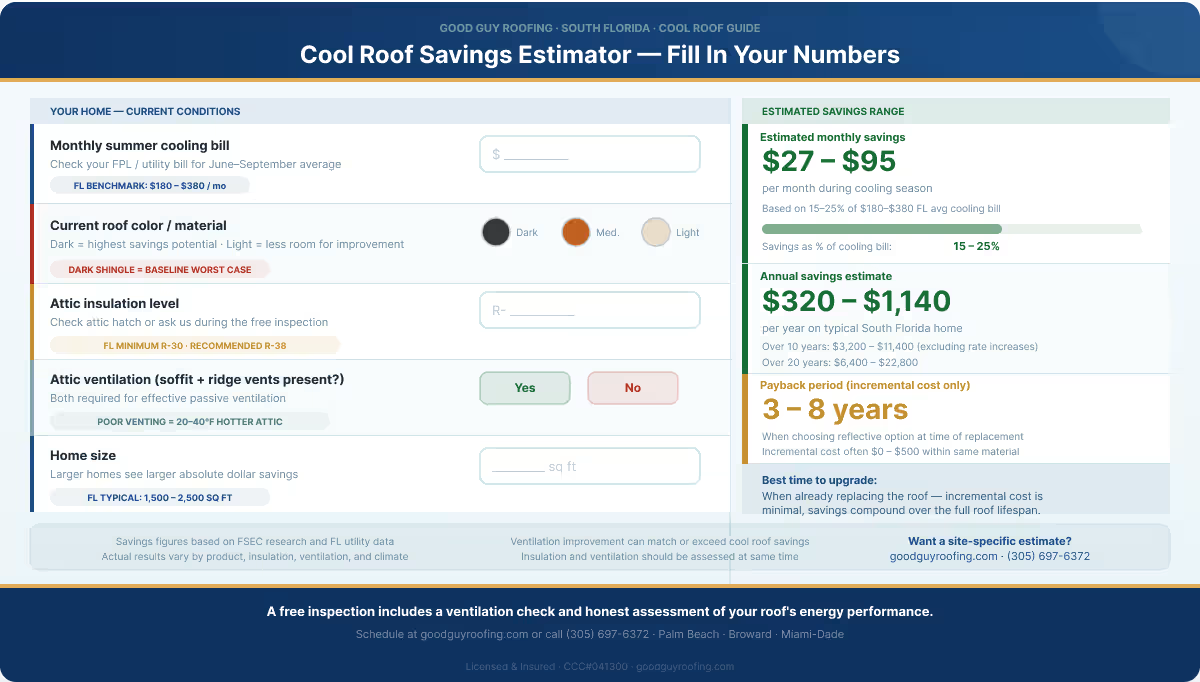
How much a cool roof actually saves depends on your home’s specific conditions. The worksheet below helps you put rough numbers on it. The benchmarks are based on Florida Solar Energy Center research and average Florida utility data.
| Factor | Your estimate | FL benchmark |
|---|---|---|
| Current monthly cooling bill (summer) | $___________ | $180 – $380 / month |
| Home size (sq ft) | $___________ | 1,500 – 2,500 sq ft typical |
| Current roof color/material | ___________ | Dark shingle = baseline |
| Attic insulation level | R-_______ | R-30 min, R-38 recommended in FL |
| Attic ventilation (soffit + ridge vents?) | Yes / No | 1 sq ft per 150 sq ft of attic |
| Estimated cool-roof savings (15–25% of cooling bill) | $___________ | $27 – $95 / month at FL benchmarks |
| Annual savings estimate | $___________ | $320 – $1,140 / year |
| Payback period estimate (if replacing anyway) | _____ years | 3 – 8 years on incremental cool-roof cost |
Savings estimates are illustrative ranges based on FSEC research. Actual savings depend on home size, insulation levels, utility rates, occupancy patterns, and specific roofing product. Request a detailed assessment for site-specific figures.
A few things the worksheet makes clear.
First, the savings are real but modest on their own – $300 to $1,100 per year is meaningful, but a cool roof is not primarily a financial decision in most cases. The financial case is strongest when you’re already replacing the roof: the incremental cost of choosing a more reflective product within the same material category is often zero or close to it, and the savings compound over the roof’s life.
Second, ventilation and insulation improvements often have a higher ROI than the roofing material choice itself – particularly if the attic is poorly ventilated or under-insulated. A $1,500 attic insulation upgrade in an under-insulated Florida home can save more than a cool-roof material choice, and it doesn’t require waiting for a roof replacement to act.
Florida Incentives and Rebates for Cool Roofs
The incentive landscape for cool roofs in Florida has changed significantly in recent years following changes to the net metering policy. However, a number of programs remain relevant:
Utility Rebates
Several Florida utilities offer rebates for Energy Star-certified roofing products and for attic insulation upgrades. FPL, Duke Energy Florida, and Tampa Electric have historically offered these programs, though availability and amounts change annually. Check with your specific utility provider before your roof replacement to confirm current offerings – and make sure your contractor can provide the Energy Star certification documentation the rebate application requires.
Federal Tax Credits
The Inflation Reduction Act extended and expanded the Residential Clean Energy Credit and the Energy Efficient Home Improvement Credit through 2032. As of 2025, homeowners may be eligible for a 30% tax credit for certain energy-efficiency improvements, including qualifying cool roof products and insulation. Tax credit eligibility depends on the specific product, its Energy Star certification, and your tax situation. Consult a tax professional for guidance specific to your circumstances – this is not tax advice.
Florida Property Tax Exemption
Florida Statute 193.624 provides a property tax exemption for the added assessed value resulting from renewable energy improvements. While primarily designed for solar installations, certain energy efficiency improvements may qualify. This is worth investigating if you’re combining a cool roof with other efficiency upgrades.
| If your roof has storm damage or an active leak alongside the energy inefficiency, addressing the structural issue first is the priority. See our roof repair and maintenance page for guidance on when to repair vs replace. |
Cool Roof Frequently Asked Questions
What is a cool roof?
A cool roof is a roofing system designed to reflect more of the sun’s solar radiation and release absorbed heat more quickly than a standard roof. The two defining properties are solar reflectance (how much sunlight the surface reflects) and thermal emittance (how efficiently the surface radiates away heat it absorbs). A standard dark asphalt shingle absorbs around 90 to 95% of incoming solar energy. A white TPO membrane reflects 70 to 80%. In Florida, where peak solar radiation is among the highest in the continental US, this difference translates directly into attic temperature – and attic temperature translates directly into air conditioning load.
Does a cool roof actually work in a humid climate like Florida?
Yes. The concern about humid climates is that warm, humid air reduces the temperature differential between the roof surface and the ambient air, making the cooling effect less pronounced. Research from the Florida Solar Energy Center has found that cool roofs in Florida reduce attic temperatures by 20 to 30 degrees Fahrenheit compared to dark roofs, and reduce cooling energy consumption by 15 to 25%. The humid air affects the absolute numbers slightly but doesn’t negate the benefit. Florida’s high solar radiation and long cooling season actually make it one of the strongest markets for cool roof performance in the country – savings compound over more cooling months than in most other states.
Which roof color is best for Florida heat?
White or very light gray gives the best thermal performance in any material category. For flat roofs, white TPO or a white silicone coating is the top performer. For pitched roofs, light gray or off-white concrete tile, white or light metal panels, or Energy Star-certified light-colored reflective shingles all significantly outperform darker options. The practical trade-off is aesthetic: many homeowners prefer the look of terracotta tile or darker colors for their neighborhood context. In those cases, specifying the lightest color that’s aesthetically acceptable is the right approach. Even moving from a dark terracotta to a medium sand-colored tile makes a measurable difference.
Does roof ventilation matter as much as the roofing material itself?
In many Florida homes, yes – and in some cases more. A well-ventilated attic can be 20 to 40 degrees cooler than a poorly ventilated one, which directly reduces the load on the ceiling below. This temperature differential is often comparable to the benefit of switching from a dark to a reflective roofing material. The most important thing to understand is that the two work together: a reflective material reduces the heat entering the attic, and ventilation removes the heat that does get in. A reflective roof with inadequate ventilation still overheats the living space. A well-ventilated attic with a dark roof still absorbs more heat than it needs to. Getting both right maximizes the result. When we inspect roofs, we include a ventilation check as part of the assessment – because the roof and attic need to be evaluated as a system.
Are there rebates or incentives for a cool roof in Florida?
Yes, though the landscape has changed. Utility rebates for Energy Star-certified roofing products are available through several Florida utilities, including FPL and Duke Energy Florida – amounts and availability change, so check with your provider before replacement. The federal Energy Efficient Home Improvement Credit (25C) under the Inflation Reduction Act may provide a 30% tax credit on qualifying products through 2032; confirm eligibility with a tax professional. Florida also offers a property tax exemption under Statute 193.624 for certain energy efficiency improvements. To access rebates, you’ll need Energy Star certification documentation for the specific product installed – your contractor should be able to provide this.
What the Right Cool Roof Can (and Can’t) Do for Your Energy Bill
A cool roof in Florida is a genuine, measurable upgrade. The savings are real, the mechanism is well-understood, and the incremental cost within a material category is usually modest. But it’s not a substitute for adequate attic ventilation and insulation, and it shouldn’t be the primary reason for replacing a roof that still has functional life remaining.
The strongest case for prioritizing cool-roof performance is when you’re already replacing the roof and choosing between material or color options – at that point, the energy-efficient choice often costs no more and performs significantly better over the roof’s lifespan. The savings compound over 20 to 40 years.
If you’d like to know how your current roof and attic conditions affect your cooling bill, a free inspection is the right starting point. We assess the roof surface, attic ventilation, and visible insulation conditions, and we’ll give you a straightforward view of what’s actually contributing to the problem and what would have the most impact.


